
By Ted Clarke – Prince George Citizen
After having three of his downtown Prince George buildings burnt down, council candidate Dan McLaren has seen enough.
He wants council to make it a priority to tackle crime, vagrancy and poverty in the city core and wants a seat at city hall to have a direct role in finding solutions.
On Sunday, Sept. 27, at an all-candidates forum at Vanier Hall, McLaren was asked if he supports using city tax money to fund social programs for residents. As McLaren pointed out, that is already happening. He pointed to a city report that showed $26 million in costs had been downloaded from senior levels of government to the municipality since 2020, much of it to pay for social services.
“When Colin Kinsley was the mayor of Prince George, we had 98 police officers. Today, we have an authorized strength of 157. At $258,000 per member, I think about what that costs us,” said McLaren.
“If you talk to the average firefighter and ask how much time they spend going to overdoses, they’ll tell you anywhere from 30 to 50 per cent of their shift. There are tens of millions of dollars everybody in this room is presently paying to clean up the mess that was created by our provincial government. I remind you, 10 years ago, the province of British Columbia declared an opioid emergency. They have done nothing and we are having to pay for it.”
On evidence-based harm reduction strategies and what should be done differently, candidate John Zukowski said council needs to continue pressing the province to provide involuntary care to treat people addicted to substances.
“That doesn’t fall under the mandate of city council,” said Zukowski. “The province has to be encouraged to get with it and open up involuntary care and create a model so there’s co-operation with the social service agencies, so that things are streaming well. Nobody should be left out, including the homeless.”
Incumbent Brian Skakun told the forum that BC’s harm reduction policies work and prevent overdoses, but acknowledged that non-profit organizations downtown lack the resources to deal with problems associated with people struggling with addictions showing up on their doorsteps.
“We have evidence right now it is working in some cases and people’s lives are changed,” said Skakun. “I think so far we’ve lost probably 50 lives to overdoses. Last year I think it was close to 80.
“Without harm reduction, we probably would have lost more people. But I think the non-profits need more support from the government with all these types of programs.”
McLaren disagreed with Skakun and said he is convinced the province’s harm reduction policy and prescribed safer-supply alternatives to illicit opioids are not fixing the problem. He said involuntary care and forced confinement to break the cycle of addiction are needed.
“Prince George has the highest death count with opioids in British Columbia,” said McLaren. “We have 100 beds at Baldy Hughes, a long-term residential drug and alcohol treatment centre for men, and only 20 are funded. I have an office at 331 George St., across from the needle exchange, and I could spend hours explaining the daily evidence why harm reduction didn’t work.
“I think we need to move to the Alberta-based model, fully fund the empty beds at Baldy Hughes and work towards getting people healthy instead of finding ways to continue their misery.”
Tim Bennett, one of five incumbent council candidates, along with Skakun, Trudy Klassen, Cori Ramsay and Ron Polillo, said close to 40 per cent of the city’s operating budget is spent on protective services — police, firefighters and bylaw enforcement — but said there is work to be done connecting with other agencies to prevent duplication of services.
Ramsay cited examples of the public library and recreational programs the city funds that are beneficial to the community.
“We get to decide how our taxes are used and we do budget engagement with residents in order to learn what you want prioritized, and I’m here to champion that,” said Ramsay, who also cited the supportive housing unit at Third Avenue and London Street.
“Without the land of those housing units coming on board, we wouldn’t have been able to close the (Moccasin Flats) encampment,” Ramsay said. “We did use city taxes. We can’t wait all the time for the province to step in, and there’s a level of balance that needs to be sorted out.”
On the question of holding the line on tax increases, candidate Shawn Bortolon said there is no clear-cut answer.
“Holding at zero per cent means that we will have cuts somewhere else, probably to jobs, which I would preferably hold against, or to increase fees on services and utilities, which is another consideration,” said Bortolon. “We have to look at revenue streams that are coming in, where we can be creative with fundraising and where we can be creative accessing alternative revenue.”
Klassen said the city has to find a way to reduce taxes, which have steadily escalated at two or three times the rate of inflation in recent years, a pocketbook pinch that is especially hurting pensioners.
“We do it by taking a thorough review of how we’re spending our money and reducing the cost of the work we’re doing, especially if you look at the cost of the civic core plan,” said Klassen. “It’s projected to cost us an additional $38 million per year. We can’t afford that. We have to look at different ways of doing this.”
James Steidle, a Prince George Secondary School metal shop teacher who holds a master’s degree in public policy, pointed out that the city’s operating budget this fiscal year has increased to $185 million, close to $32 million more than three years ago, and taxpayers are footing the bill.
“I’d love to hold our taxes,” said Steidle. “The city can’t run deficits, so our taxes have gone up 27 per cent in the past four years. This is unsustainable.”
He said the province is clawing back its property-tax support and plans to phase out the $200 Northern and Homeowner Benefit by the 2027 tax year.
“That’s ($6.4) million that’s basically been downloaded to the taxpayers of Prince George, so we need more help from the province,” Steidle said.
On the topic of balancing fiscal responsibility with fair wages, safe working conditions and the city’s ability to recruit and retain employees, Nicole Fraser, a former city planner, said not having a workplace in which employees feel safe raising job-related concerns negatively affects productivity among city staff.
“If we take care of the psychological safety and well-being of employees, that is where we’ll see a lot of financial savings realized,” said Fraser. “Because at the end of the day, if you have workers you can’t retain and recruit because they feel unsafe to come forward if they have a complaint and they don’t feel protected, that is going to have consequences for things like permits.”
Retired firefighter Dan Pears said he has seen firsthand some of his colleagues in Prince George Fire Rescue suffering from PTSD and knows how crucial it is to have psychological supports in place for everybody who needs them.
“That’s a cost you can’t cut,” said Pears. “Fair wages is an essential thing too. That will get us better work quality and safer conditions and support apprenticeships and things like that.”
Bruce Wayne said the city needs to adopt a whistleblower policy and allow anonymous reporting from staff so they feel able to speak up about workplace conditions and point out any injustices without fear of reprisal.
Candidates were asked what they could do to make Prince George a better place.
Polillo said improving public safety is paramount and that infrastructure investment in civic facilities is also key. He also highlighted the need for a better transit system that is accessible and inclusive to serve residents with special needs.
Zurowski said the city has to get a handle on excessive spending and that once the city starts saving tax revenue, that will help reduce the financial stress residents are now feeling.
Candidates were asked when they would support discussing an issue at an in-camera meeting without public disclosure and what responsibility council has to make that information public once confidentiality is no longer necessary.
Bob Radloff, a former city public works director, said municipalities are governed by provincial regulations and restrictions on publicly disclosing matters related to labour, land and laws, and councillors must respect that obligation, which he supports.
“In terms of making information public after a closed session, that is not allowed,” said Radloff. “We would want to respect confidentiality of decisions made by council.”
Skakun, who has served on council for 18 years, said he has had “way too many” closed meetings, especially over the past four years, that he felt should have been open to the public. He wants council to be more transparent.
Bennett pointed to the dubious honour given to Prince George when the Canadian Association of Journalists named the city the winner of its 2022 Code of Silence Award for Outstanding Achievement in Government Secrecy. The award stemmed from the George Street Parkade cost overrun that nearly tripled the price to $34 million.
“In 2022 there were 40 in-camera meetings that year,” said Bennett. “This year to date we’re at 17. We’ve taken that challenge that was thrust upon us around confidentiality and we’re doing more business and we’re reporting more, whether it’s quarterly or semi-annually.”
As Fraser pointed out, the BC ombudsperson issued a guide for best practices that recommends open meetings as a best practice for local governments, but nearly 13 per cent of all complaints the ombudsperson received were about local governments.
“Without transparency there’s no trust,” said Fraser. “We’ve all seen the headline over the parkade. The trust has been shattered.”
On the topic of what initiatives council can bring to address the increasing problem of food insecurity and affordability for Prince George residents, Anthony Okechukwu, an economist, said that starts with forming alliances with local farmers.
“It’s very simple. We need to support our farmers, so food is available for everybody,” said Okechukwu. “We need to start creating policies that will support the people that actually produce food.”
Tucker Krause, a 20-year-old UNBC economics student, spoke about his plan to work with other councillors and not against them and bring “next-generation” representation to council to give more people his age a reason to remain in the city.
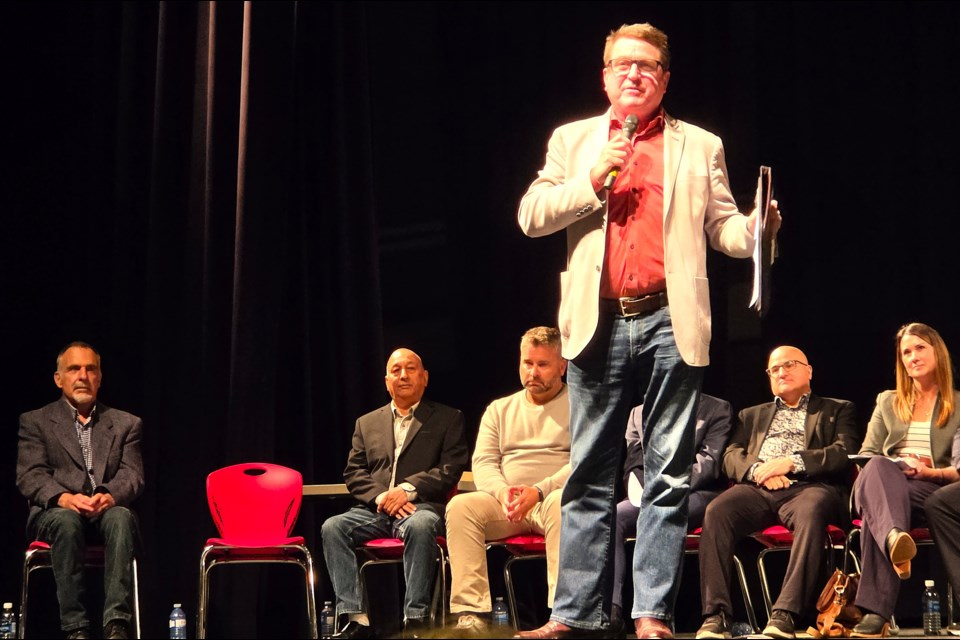
All 18 council candidates, including Jesi Janjua, Trenton Laarz and Rajinder Parmar, participated in the forum, organized by the North Central Labour Council and moderated by council vice-president Candis Johnson.
A video recording of the council forum, as well as the mayoral and school trustee forums that preceded it on Sunday, will be posted on the NCLC Facebook page.
The municipal election will be held Saturday, Oct. 17.
Advanced voting will be available Oct. 7, 8, 14 and 15 from 8 a.m. to 8 p.m. at the Prince George Conference and Civic Centre.
VIEW ORIGINAL ARTICLE: https://www.princegeorgecitizen.com/local-news/council-race-heats-up-in-all-candidates-forum-12829087